 Skip to content


Let’s imagine that you get a call. It’s a potential welding job, and the client is willing to pay you mucho dinero if you’ll repair a metal structure for them. The catch: It’s in the middle of nowhere. No roads, no power sockets, nothing. What machine would you use?
How about a different scenario? You need to weld up an old gate on your property but currently don’t own a generator capable of supporting a welding machine. Is your only option to go buy a new generator?
There are thousands of situations where a power outlet isn’t an option and a generator isn’t ideal. Up until a few years ago, there wasn’t a good solution to this problem. Recently, though, some of the top brands in the welding industry have released NEW battery-powered welders. These machines offer an unrivaled level of portability. In this article, we’ll tell you everything you need to know while comparing the top machines.
Ultimate Freedom
With a battery-powered welder, you’re completely free of the grid. Sure, engine-driven welders allow you to work without access to site power, but they require a vehicle capable of handling their weight and can’t be easily maneuvered around. On the other hand, these battery-powered machines are incredibly light (between 27 and 51 lbs). You can bring them on roofs or lifts with ease. They’ll fit in any vehicle or can even be carried by hand, making them ideal for farm maintenance, off-roading vehicle repairs, outdoor work, and more.

Battery-powered welders are also incredibly fast and easy to set up compared to generators or engine-driven welders. Have a five-minute repair job? Just flip the power switch, and you're in business. That’s a level of convenience never before experienced when welding away from the grid.
Battery-powered welders are also a perfect solution for jobs with noise restrictions. For instance, when welding near residential areas, you typically have certain hours you can’t be running a noisy generator. These battery-powered welders are significantly quieter. This can be the difference between being able to weld early in the morning before the heat, or having to wait until you can run a generator when it’s much hotter.
Key Factors to Consider: Batteries
While battery-powered machines give you incredible freedom to weld virtually anywhere at any time, a few important factors can ultimately make or break your experience with them.
First, let’s talk about the “battery” aspect of battery-powered welders. We know what you’re saying: “Duh, battery-powered welders require batteries. Thanks, Captain Obvious.” Okay, well, that’s Commander Obvious to you, and actually it isn’t so obvious when you start to look at the specifics. Between the 3 top brands, each one takes a different approach to how its battery solution works.
The Lincoln ELEVATE SLi has the lowest price point of the battery-powered welders and takes the simplest approach. Its battery is built right into the machine. You charge it, use it, charge it again. It uses a standard 120-volt plug to charge, so typically charging it isn’t an issue. The downside of this simplicity is that if you run out of charge mid-job, you cannot swap batteries and begin welding again. You also cannot plug the machine in and weld with it while it charges. You must stop, wait for the battery to recharge, then begin welding again.

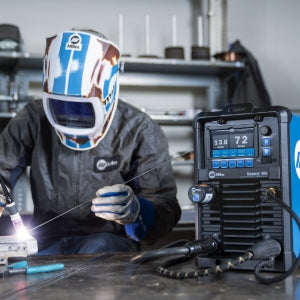
Miller’s Venture 150 uses a replaceable battery. This means that you can weld with one battery while another battery is charging, hypothetically allowing you to continuously weld all day. The batteries are lightweight, ensuring the Venture stays incredibly portable, and they charge incredibly fast (under 30 minutes to 95% in “fast mode”). It’s a really slick setup, but it requires two batteries to take advantage of. This is why we’d recommend the Venture 150 options that come with an extra battery.
ESAB looked at Lincoln’s and Miller’s battery solutions and said, “Let’s do something totally different.” Instead of a built-in battery or specially made battery, they use Dewalt FLEXVOLT batteries. To be more specific, it uses four Dewalt batteries all at the same time. While the machine comes with four batteries to begin with, ideally you’d have four other batteries to swap to once those run out of juice.
This makes ESAB’s VOLT perfect if you already use Dewalt FLEXVOLT batteries for other equipment. The downside of needing four batteries instead of one is weight. The Volt weighs 51 lbs with its batteries, whereas the Venture weighs 27 lbs, and the ELEVATE weighs 33 lbs. It should be noted that the Volt is the only machine of the three that can also be plugged in and run like a normal welding machine while you have access to the grid.
Key Factors to Consider: Process
When deciding which battery-powered welder is right for you, you need to consider what process you plan on using. Stick is a popular option for this type of machine, as you don’t have to worry about hauling around shielding gas. You show up with your machine, flip the switch, clamp on your rod, and get to welding.
If you plan on mainly using stick, here are the battery-powered welders we’d recommend:
- Lincoln ELEVATE SLi
- Miller Venture 150 S
- ESAB Renegade VOLT EMP 200i
When it comes to TIG welding, all the machines listed above can technically do TIG and stick. HOWEVER, if you’re a TIG professional, we’d strongly recommend the Miller Venture 150 T instead of the Miller Venture 150 S. The “T” version of the Venture 150 is entirely designed around TIG welding. It has several features that the “S” version doesn’t, including high-frequency TIG starts, Pulsed TIG QuietPulse, an integrated gas valve, and more.

Just remember that with TIG welding, you will need a shielding gas cylinder separate from the machine in order to properly weld. Obviously, shielding gas doesn’t require power, but it is something to consider when thinking about the portability of your setup. Instead of your typical large welding cylinder, you might want to consider a smaller-sized option to store your shielding gas.
For MIG welding, there’s currently only one battery-powered option on the market: the ESAB Renegade VOLT EMP 200i. This is a multi-process version of the VOLT machine and also runs on 4 Dewalt FLEXVOLT batteries. You should be aware, though, that the VOLT EMP doesn’t have a built-in drive roll, meaning to MIG, you will need a compatible spool gun.

The awesome thing with the ESAB Renegade VOLT EMP 200i is that it can MIG weld and flux-core. Flux-cored welding has the shielding gas baked right into the wire, so you don’t have to worry about hauling around shielding gas cylinders. This essentially allows you the portability of stick welding, but is much more similar to the MIG process.
Based on the key factors mentioned in this guide, you should be able to find a battery-powered welder that matches your specific needs. The level of portability they offer is unmatched by any other equipment, and with the right steps, they can take your abilities to places you’d never be able to weld before (literally and figuratively). For the best selection and prices on battery-powered welders and accessories, check out Welding Supplies from IOC’s full selection here.
