Skip to content

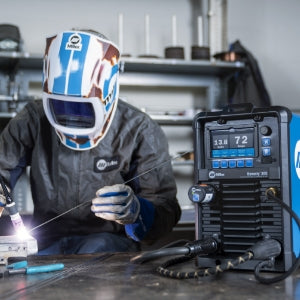

Flux-core is the Hunchback of welding processes. Like Quasimodo of Notre Dame, flux-cored welding is sometimes cast away because of its hideous appearance. But with a little bit of love and a grinder, flux-core cleans up really nicely.
In fact, flux-core (also called FCAW) has some serious advantages that can actually make it the best process in certain situations, especially for beginners looking to get into welding as a hobby. In this article, we’ll cover why you should care about flux-core and how to get started.
What Is Flux-Core Welding?
Flux-core welding, or flux-cored arc welding (FCAW), is an arc welding process that uses a continuously fed tubular electrode containing a flux to produce the weld. The process is similar to MIG (metal inert gas) welding, but instead of relying on an external gas shield to protect the weld, the flux inside the electrode provides the necessary shielding to prevent atmospheric contamination.
There are primarily two types of flux-cored wires:
Self-shielded (FCAW-S): These wires do not require any external shielding gas. The flux inside the wire produces a gas that, when burned, shields the weld.
Gas-shielded (FCAW-G): These wires require an external shielding gas, usually carbon dioxide or a mixture of carbon dioxide and argon. The flux and the gas together provide optimal protection for the weld.
Advantages of Flux-Core Welding
- Portability: Since FCAW can use self-shielding wire, it doesn't necessarily require gas tanks, making it suitable for outdoor applications and fieldwork.
- Penetration: FCAW typically provides deeper weld penetration compared to other processes, making it ideal for thicker materials.
- Metal Transfer: The process has a higher metal transfer efficiency, which can lead to faster deposition rates.
Disadvantages of Flux-Core Welding
- Slag: The flux inside the wire often leaves a slag covering on the weld that needs to be chipped away post-welding. This can be seen as an additional step when compared to MIG welding.
- Smoke and Fumes: FCAW can produce a significant amount of smoke and fumes, so proper ventilation is essential.
Applications
FCAW is widely used in construction, heavy equipment manufacturing, shipbuilding, and other industries where thick materials and high deposition rates are required.
Equipment
Flux-cored welding equipment typically includes a welding gun, a wire feed system, a power source, and, if using gas-shielded wires, a gas supply system.
Wire Selection
The selection of the appropriate flux-cored wire is critical for achieving the desired weld properties. Wire selection can be influenced by the base material, desired weld properties, and specific application requirements.
Flux-cored welding has been a valuable tool in the welding industry because of its flexibility, portability, and ability to work well on thicker materials and in challenging environments. However, like all welding processes, it requires proper training and understanding to be used effectively and safely.
Why Is it Called Gasless MIG Welding?
Because flux-core welding does not require separate shielding gas tanks, it's sometimes referred to as "gassless MIG welding." However, the term gasless is about as accurate as the Bear’s quarterbacks'. With normal MIG welding (or GMAW), an external shielding gas is needed to protect your weld from oxygen, as it will cause the metal to corrode.
While flux-core doesn’t require external gas cylinders with shielding gas, it is not actually “gasless.” Instead, the wire it uses already contains a shielding gas, which is released as you weld. Hence, why flux-core MIG welders are effective.
This makes flux-core a great option for someone looking to get started in welding. Welding already requires a lot of equipment. Flux-core makes it possible to begin welding without having to purchase and fill tanks of shielding gas, which slightly lowers the barrier to entry.
While stick welding also uses electrodes that already include shielding gas, stick welding can be quite tricky to do well. Flux-core takes the accessibility of MIG welding and makes its upfront costs cheaper. It also actually performs better in outside conditions, especially in windy weather.
It’s important to know that flux-core has a lower starting cost, but the price of flux-cored wire is more than MIG wire. If you know you’re going to be doing a lot of welding and don’t mind the initial investment, GMAW (MIG welding) might be the better option. That being said, many MIG machines will also do flux-core. You can always start with flux-cored wire and graduate to your own external gas tanks. If this is your plan, just make sure you double-check that the machine you’re interested in can do both processes before you purchase. For instance, the Millermatic 211 is one of our favorite MIG welders of all time and can do both FCAW and GMAW.
How To Use a Flux-Core Welder: The Basics
First and foremost, if you want to know how to use a flux welder, you’ll need to make sure you have a welding machine capable of flux-cored welding. Here’s a complete list of all the top FCAW machines offered from the best store on the web. You’ll also need flux-cored wire, which you can purchase at the best price online here.
Setting up your machine depends a lot on the specific equipment you’re using. Consult your user manual and reference grid to get the right settings for the material and thickness you’ll be welding.
One of the most important things to remember is that flux-core requires DC electrode-negative polarity, the opposite of MIG welding. Depending on your machine, you might need to switch your leads around. If you find you’re unable to produce a good weld, polarity should be the first area of troubleshooting. There is nothing more frustrating than spending hours trying to weld, only to realize you needed to make a 30-second adjustment.
Also, pay special attention to your drive roll tension and wire speed. Most experienced flux-core welders set their tension so they can easily halt the wire with a finger.
Ugly Welds
Even when done right, flux-cored welds look awful at first. You’ll notice a significant amount of spatter, smoke, and sparks compared to MIG and TIG welding. Once you finish your weld, clean-up is required. Use a grinder and wire brush to remove the slag, spatter, and smoke residue. Your beads should look significantly better once you’re done.
Because FCAW just looks ugly, it can be hard for beginners to know if they’re doing it right or doing something wrong until after they’ve cleaned it up. Ultimately, the best solution here is to practice. Make sure you use a scrap piece of metal and try laying a few beads. The trick is to know what angle, distance, and speed you need without as much visual feedback as you’d get from MIG or TIG. Once you’re able to trust the process, you can create welds that are as strong and as good-looking as MIG.
Frequently Asked Questions
Is flux-core welding good for beginners?
Yes. Self-shielded flux-core needs no gas tanks, tolerates wind, and handles dirty or rusty metal better than solid-wire MIG, so there is less to set up and less that can go wrong. That forgiveness is exactly why it is one of the most accessible ways to start laying real beads.
Do you need gas for flux-core welding?
It depends on the wire. Self-shielded wire (FCAW-S) makes its own shielding as the flux burns, so no external gas is needed. Gas-shielded wire (FCAW-G) does require a cylinder, usually carbon dioxide or a carbon dioxide and argon mix. You choose the flux-cored wire to match the job.
Can any MIG welder run flux-core wire?
Many wire-feed machines can, as long as they support DC electrode-negative polarity and you fit the right drive roll for tubular wire. Some machines are flux-core only, while most modern MIG units switch between both. You can see the FCAW-capable machines that handle it.
What polarity does flux-core welding use?
Self-shielded flux-core runs on DC electrode-negative, also called straight polarity, which is the opposite of solid-wire MIG. If you switch a machine from MIG to flux-core, flipping the polarity leads is one of the first things to check, since the wrong polarity is the most common reason beginners get poor results.
Is flux-core stronger than MIG?
Neither is simply stronger. Flux-core gives deeper penetration on thick steel and performs better outdoors and on less-than-clean metal, while solid-wire MIG runs cleaner on thin material with less spatter and no slag. A properly made weld with either process can be plenty strong; the right choice comes down to the material and the conditions.
Why do my flux-core welds look so ugly, and how do I clean them up?
Spatter, smoke, and a layer of slag are normal for flux-core, even on good welds. Chip the slag off with a hammer and wire brush to reveal the bead underneath, then judge your work. If the weld itself is inconsistent, check your polarity, voltage, wire speed, and a steady drag-angle travel before blaming the process.
Your Next Step
Ready to put this into practice? Load up on the right flux-cored wire, and if you still need a machine, our MIG and wire-feed welders cover everything from a first flux-core setup to a shop workhorse.
Don’t forget Welding Supplies from IOC has the best prices on the brands you can trust. If you’re interested in flux-cored welding, make sure to check with IOC before you buy.