Skip to content


When we were kids, there was an old legend passed down about a crazy cat lady. One of her favorite cats had snuck out in the rain and gotten all wet and cold. Unable to find any clean towels to dry the animal off, the woman tried her hair dryer instead, but found that the other cats had chewed through the cord. Thinking for a second, the woman realized she used her microwave all the time to warm things up. What better way to get Mr. Mittens dry and toasty in just two minutes and 30 seconds? And that was the explosive end of her favorite cat.
Every kid in the neighborhood knew this story. It was a legend. You might have heard a similar story at one point in your life. Because true legends stick with you so much, they don’t just disappear.
For every TIG welder, the Lincoln Square Wave 200 is a legend just like that. Maybe you’ve never used one, but there’s a good chance you’ve heard of it. So when Lincoln announced they were done making the Square Wave 200 and replacing it with a new machine, we wondered: Was the legend done, or would it live on?

Join us as we dive into all the dirty details of the new Lincoln Square Wave 205 and see if this new successor is worthy of the legendary “Square Wave” name.
Just 5 Amps?
“So is the only difference 5 amps?” That was our immediate reaction when we learned the Square Wave 200 would be replaced by the Square Wave 205.

In case you didn’t know: The number in most welding machine names often indicates how much power output that machine is capable of producing. For instance, the Square Wave TIG 200 was capable of 200 amps. And the new Square Wave 205? You guessed it: 205 amps.
While 205 amps is an incredibly impressive amount of power for a machine like this, Lincoln has made so many other significant improvements beyond a simple increase of 5 amps. Here are some of the most notable changes:
Designed by Welders, for Welders
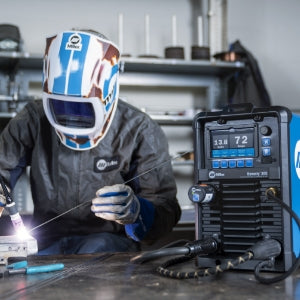
TIG welding ain’t easy. But your machine shouldn’t make it harder. The new Square Wave 205 was completely designed around making your life easier. As part of this, the old knobs and buttons of the Square Wave 200 have been upgraded to an LCD screen that’s significantly easier to use.

For instance, no more needing to dive into the manual to figure out how to adjust every little setting. The new Square Wave interface is incredibly straightforward. This makes quickly finding and changing any parameter incredibly easy. Even for less-experienced TIG welders, getting this machine up and running takes a fraction of the time compared to other options.
While the new interface is designed to be straightforward, experienced welders will be able to access all the settings they want for more fine-tuning. If you’re someone who loved the old Square Wave 200 settings panel, you’ll still feel right at home with the 205. It’s just a better home now with a bigger view.
All the Metals
What types of material can the new Square Wave 205 weld? A better question is, what metals can’t the Square Wave 205 weld? If you know what you’re doing, you can weld stainless steel, chrome-moly, many different nickel alloys, and even cast iron and titanium. But where you’ll see some of the best features with the 205 is with welding aluminum and mild steel.

With the ever-increasing popularity of aluminum, Lincoln specifically designed the Square Wave 205 to tackle this type of material like a pro. In particular, it can be hard to pinpoint the right setting for aluminum, as it transfers heat quickly but also has a much lower melting point than steel. This is why welders often feel like they need to keep increasing the heat on aluminum, and then all of a sudden, it's too hot. To help you handle that, the Square Wave 205 has AC Frequency Control to dial in the ideal parameters and bead width.
For thicker pieces of aluminum, the Square Wave 205 also features AC Balance for enhanced cleaning and optimized penetration. Both of these improvements allow you to handle tricky materials with precision and ease.
Do Your Duty
Every welder has heard of duty cycle, but many don’t fully understand what it means. Basically, your machine is like you: It can only work so hard before it needs to cool off, or it’ll fry its circuits. The higher the power, the less time your machine can run before it needs to cool off.
On the old Square Wave TIG 200, if you were running the machine on a 240-volt socket at 130 amps, you could weld for 6 minutes. Then you’d need to let it sit for 4 minutes (60% duty cycle). With the new Square Wave 205 at 130 amps, you have a 100% duty cycle. That means you technically never need to stop welding at that power setting (though keep in mind, the torch you use also has a duty cycle).
Of course, the duty cycle for the new Square Wave 205 isn’t 100% at every power level, but it has been completely improved compared to the old 200. On a 230-volt plug at 160 amps, the duty cycle is 60% (up from 40%) and 25% on 205 amps. On a 120-volt plug, the duty cycle has also been improved. To see more duty-cycle details, check out the specs here.
And So Much More
Beyond its improved user friendliness, better duty cycle, and ability to work with a variety of metals, the Square Wave 205 has several other positive changes. It’s lighter than its predecessor and has the ability to both AC and DC stick weld.

When rebuilding a legend like the Square Wave 200, Lincoln knew they had to focus on the improvements that welders wanted most. The new Square Wave 205 is an impressive step up from its predecessor, but the core of its design still focuses on everything that made the original Square Wave so great. To learn more about pricing and see the specs for yourself, check out Welding Supplies from IOC here.