Skip to content


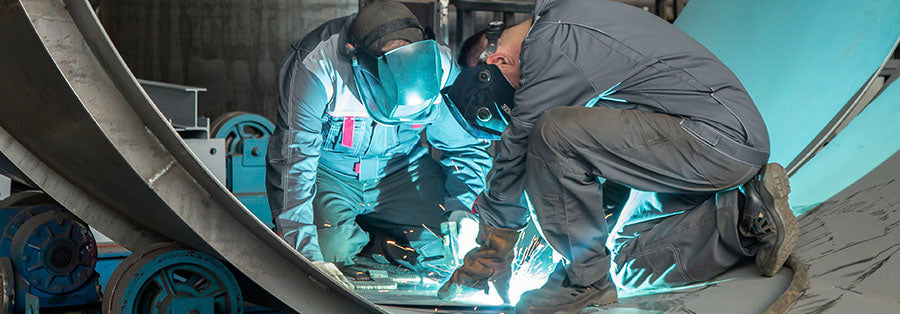
Typical welders love steel. It’s easy to use, can take a lot of heat, and is fairly cheap. But engineers and manufacturers… they love aluminum. Compared to steel, aluminum weighs much less, and it doesn’t rust like steel or rot like wood. In fact, global aluminum production has doubled since the year 2000, and it’s expected to increase another 40% by 2030.
Whether you're working on vehicles & trailers, sculptures, fabrication, or even some construction, aluminum is quickly becoming a metal you can’t avoid. For some welders, that presents a challenging question: Which process works best with aluminum? Today, we’ll take an in-depth look at the facts and help you decide which option is best for you.
Know Your Enemy
As our old karate master once said to us, “Before you crush your enemy, you must understand him.” Then 2-weeks later, his dojo went out of business, and we were forever stuck on our blue belt. But his wise words still hold true, especially when welding tricky materials.
To “crush” aluminum, there are two major concepts you need to understand: heating and oxidation.

First, let’s talk about heat. Aluminum transfers heat 3-5x faster than steel. When you heat it with a torch, all that warmth quickly spreads out. This quickly decreases the amount of heat at the place of main contact, but heats up all the material in the surrounding area. On top of other issues, this is why aluminum tends to warp more easily than steel.
However, aluminum also has a lower melting point than steel. What often happens is that a welder will keep cranking up their heat because the aluminum keeps cooling down, and then all at once, the material has gotten too hot. It’s a tricky balance between focusing your heat enough to create a weld pool without overheating the area surrounding your weld pool.
The second challenge is that aluminum has a unique oxide layer. When exposed to air, aluminum forms a coating, somewhat similar to how steel forms rust. But while rust is bad and causes your steel to deteriorate, the oxide layer on aluminum protects it. But it can also cause problems with welding.
Is Cleaning Aluminum Required?
So, how do you deal with the oxide layer on aluminum? There’s a myth passed around online that you can completely remove the oxide layer by thoroughly cleaning your piece. This is partly true but mostly false. Aluminum forms an oxide layer within milliseconds of contacting air. So, unless you’re welding in outer space, the instant you clean off the oxide layer, it’s going to reform.

However, when the oxide layer first forms, it’s very thin – thin enough to weld through without issue. Over time, the oxide layer slowly thickens to the point where you won’t be able to properly weld through it. How you clean aluminum before welding and how often depends on a lot of different factors, including your environment, the process you’re using, and the purpose of your weld. Certain industries take cleaning aluminum very seriously and will require you to use powerful prepping solutions before you weld. If there’s ever any doubt, just clean your material. That way, you won’t have to worry if the oxide layer is too thick.
As a note, dirty aluminum also has the same problem as any material. Regardless of the oxide layer thickness, if you have grease or dirt on your weld surface, it’s going to contaminate your weld pool.
AC All the Way
As we mentioned, the goal of cleaning is to remove any thick oxide layers, even though a thinner one will instantly form. So how do you deal with the thin layer?
Welding with alternating current (AC) allows you to break through aluminum’s thin oxide layers, which is why you cannot DC weld this type of material. If you have a multiprocess welder (or are thinking about getting one), this is a big deal. Only 3 consumer multiprocess welders can AC and DC TIG weld: The Miller Multimatic 220, the Lincoln Power MIG 220, and the ESAB Rebel EMP 205ic.
MIG Welding Aluminum
Now that we understand how heat and oxidation work with aluminum, it’ll be easier to understand which process is best for you. For many welders, MIG is a favorite because it’s fast and easy to learn (though difficult to master). However, basic MIG machines are typically not set up to weld aluminum. Aluminum wire is much weaker than steel wire. This means if you tried to push aluminum wire from your machine’s drive wheel to your nozzle, it’d most likely break inside your liner. Because of this, MIG welding aluminum often requires a spool gun instead of a typical MIG gun.

Another factor to consider with most MIG machines is that you can’t easily change your settings mid-weld. You set the voltage and wirespeed, then pull the trigger and weld your full bead. Yes, we know there are some tricky MIG welders out there who can change their settings mid-weld, but doing that well is a fairly rare skill. This means when MIG welding aluminum, you need to be precise, quick, and consistent to manage your heat. Even when done correctly, warping can be a major issue. We’d recommend clamping your piece as best as you can and pre-heating thicker aluminum.
With MIG, you typically want to start with a little higher settings than you’d use on steel. The aluminum is going to spread your heat out much quicker than you’re used to, so you want to quickly reach the melting point and then move. The more you sit in one spot, the more warpage and other problems you’re going to have. However, if you move too quickly, you won’t get adequate penetration. It’s a balancing act to find the right travel speed with aluminum.
For most welders, the hardest part is going to be getting the right settings and mastering their travel speed. We’d highly recommend practicing on an unused piece of the same aluminum you’re welding until you see the results you want. Even the difference of one volt or a slight adjustment to your wire speed can make a big difference with aluminum.
TIG Welding Aluminum
TIG welding has some advantages when it comes to precisely controlling your heat compared to MIG. Remember, control is difficult with aluminum as it often feels like “nothing is happening… nothing is happening… Oh no, too hot! Too hot!”
With TIG, you’re able to taper your heat down as needed mid-weld. Done correctly, this should lead to less warpage and less cleaning after your weld compared to MIG. Since you’re manually dabbing in your filler metal, you’re also able to control when you want to add material (unlike MIG, which adds the wire at a constant rate).

One benefit and also downside of TIG is that typically your traveling speed is slower. Since you can control your heat more carefully, this allows you to slow down a little and concentrate better compared to MIG. However, if you’ve got a lot of aluminum welding to get through, TIG will typically take you longer.
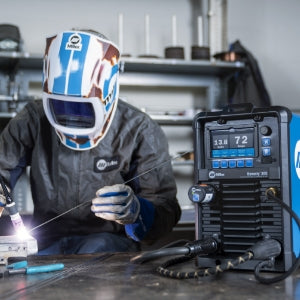
Remember, you must AC TIG weld with aluminum. This can be an issue as there are many TIG machines unable to do AC, especially multiprocess machines. If you’re purchasing a new machine for welding aluminum, make sure it can do both AC and DC TIG welding. Here are a few of our favorites:
Which is Best: Facing Reality
Here’s the deal: You’ll see TIG experts say, “TIG is always best for everyone when welding aluminum.” And on the other hand, you’ll see MIG experts say, “I tried TIG aluminum, and it was garbage compared to what I could do with MIG.”
The reality is that controlling your heat and precision are the biggest challenges when welding aluminum. If you’ve got 10 years of MIG experience and only dabbled in TIG, chances are that you’re going to do better with MIG. You’re going to know how to fine-tune your settings better, you’re going to be more confident with your speed, and you’re much less likely to get stuck in one spot compared to a process you’re less familiar with.

If you’re equally skilled in both MIG and TIG, TIG will allow you to control your heat and filler material more precisely. Especially for thin aluminum, this can be a huge benefit. Warping can also be less of an issue with TIG, which is why it’s preferred for high-precision pieces.
However, in some situations, speed might be more important than precision. If you’re welding a big aluminum frame, being able to hold down that MIG trigger and fly down a line is a big advantage over TIG. The reality is that your personal skill level with each process and the factors around the piece should determine which process you use. There is no one-size-fits-all in this case.
But there is a one-size-fits-all solution when it comes to where you buy your welding equipment. At Welding Supplies from IOC, we’re a trusted partner with only the most reliable, top brands. On top of that, we have incredible customer service and the best prices available. Check out some of our favorite machines for welding aluminum here.