 Skip to content

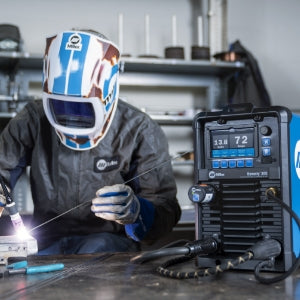

Some of us here at IOC are old. We’re talking “old” like, “back when welding was done by banging two rocks together, and you rode to work on a dinosaur” – back when the 1st multiprocess machine was introduced – back in 2012 (a.k.a. “Ancient times” for some of you whippersnappers).
Back then, that first multiprocess machine was pretty magical, but also incredibly limited — especially when it came to welding different types of materials. It combined 3 machines into 1, but really struggled with welding aluminum and stainless. This has been an issue that’s continued to plague multiprocess machines for a decade, until now…
The Lincoln Power MIG 220 is one of a few multiprocess machines capable of AC/DC TIG, MIG, and stick, making it able to weld a huge range of materials. Because of its advanced versatility, the Power MIG 220 can feel intimidating to use. But it’s actually one of the most user-friendly machines in the world… as long as you read our short guide that covers a few critical steps. Here’s everything you need to know about using the Lincoln Power MIG 220 multiprocess machine.
Getting Started
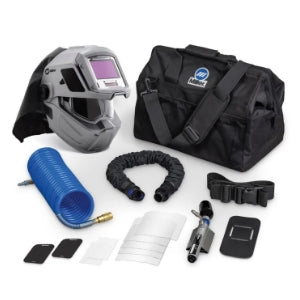
If you purchase the Lincoln Power MIG 220 from Welding Supplies from IOC, it comes with almost everything you’ll need to get started. We include a MIG gun, TIG torch, leads, TIG consumables, gas hose, regulator, and a 2 lb sample spool of SuperArc L-56 .030 mild steel MIG wire. In order to get MIG welding right away, all you initially need is a gas cylinder filled with the correct shielding gas and an outlet or generator to power the machine. The Power MIG 220 can run on both 120-volt and 230-volt power sources, though you’ll get the most output from a 230 socket.
For TIG welding, we provide you with everything except filler rods, a cylinder with shielding gas, and a power source. For stick welding, since the shielding gas is fused into the rods, you’ll only need stick electrodes and a power source. In other words, besides a few consumables, gas, and power, you’re given everything else you need to start welding with the Power MIG 220.
One nice feature of the Power MIG 220 is its dual selenoids, which allow you to have separate gas cylinders simultaneously plugged in for both MIG and TIG. It may seem like a little thing, but it’s a really nice time-saver if you swap between MIG and TIG frequently.
Once you’ve got everything connected, it’s time to flip the power switch on at the back of the machine and boot this baby up!
MIG Welding
The Lincoln Power MIG 220 makes good use of its 7” full-color LCD display. Once the machine boots, it’ll show you several icons for each type of process it can do: MIG, TIG, Flux-Core, and Stick. To begin in MIG mode, simply scroll the right knob over to the GMAW icon and push the knob in to select it.
At this point, the interface will ask you if you’d like a “Guided Setup” or “Manual.” For most welders, we’d strongly recommend starting with the guided setup. There are some highly experienced welders out there who might prefer manual mode, but the “Guided Setup” will give you the ideal starting parameters, and you can tweak them after if you’d like.

In the guided mode, the machine will ask you for your wire type, your gas type, your wire diameter, and the thickness of your material. Finally, the machine is going to instruct you on how to set up your polarity. As this is a multiprocess machine, you’ll often need to alter your leads when changing between different settings. When starting a new process, the machine will always ask you to confirm your polarity before you begin welding.
Once you’ve completed that, the Lincoln Power MIG 220 will start you off with the ideal settings based on your situation. Again, you can adjust your parameters as you see fit at any time. This streamlines the setup process but still gives you complete control when you want it.
From here, you can squeeze the trigger, and you’re off. The Lincoln Power MIG 220 is capable of MIG welding material up to 3/8" thick in a single pass. If you’re planning to MIG weld aluminum, you will need to purchase a compatible spool gun separately. For more on MIG welding aluminum, check out our guide here.
Please note that the process is very similar for flux-core welding with the Power MIG 220, only an external shielding gas is not required.
TIG Welding
One of the biggest benefits of the Lincoln Power MIG 220 over other multiprocess machines is the ability to TIG weld aluminum. This requires AC TIG.
Once the machine has booted up, you’ll turn the right knob to the GTAW icon and select it by pushing the knob in. You’ll be asked if you’d like to do a “Guided Setup” or “Manual.” The machine will then ask you which type of TIG welding you’d like to do: High-Frequency AC, High-Frequency DC, or Touch Start DC. It’ll also ask if you want Pulse TIG or not. Then you’ll input your wire type, tungsten size, gas type, and material thickness. Finally, it’ll tell you how you should set your leads for the correct polarity.

One common issue with setup is that welders will often forget to plug in the TIG pedal included with this machine. Doing so will prevent high-frequency TIG from appearing as an option on the setup screen. If you are not seeing high-frequency options, you need to plug in a pedal or some other compatible remote control connector.
The Lincoln Power MIG 220 is rated to weld up to 5/32" thick material with a single pass. Between its AC and DC capabilities, it can TIG pretty much any common type of metal, including steel, stainless, and aluminum.
Stick Welding
Stick mode with the Lincoln Power MIG 220 is very similar to the startup process for TIG and MIG. The only major difference is that a shielding gas is not required to get started.

To begin, select the SMAW icon. Then you’ll have the option to do a “Guided Setup” or “Manual.” We recommend the guided setup to start, as you can always tweak your settings later. You then have the option to choose a “soft” arc or a “crisp arc.” A “soft arc” is easier to manipulate with less spatter, but a “crisp arc” is better for penetration.
Once you select your arc type, you’ll be asked what electrode you’re using and its diameter. Finally, you’ll select your plate thickness and adjust your polarity. That’s all it takes to get started with stick welding on the Lincoln Power MIG 220 multiprocess machine.

Not only can the Lincoln Power MIG 220 handle a diverse range of welding situations, but it’s one of the easiest machines to use on the market today. For a look at the best price available on the web, check out all the details at Welding Supplies from IOC.

