 Skip to content

Miller Dynasty 210 Tig Welder 120-480V (907685)
 Download Product Spec Sheet

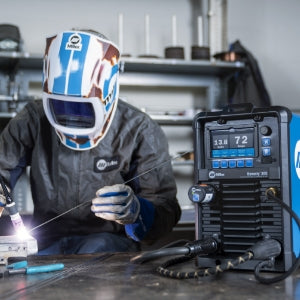
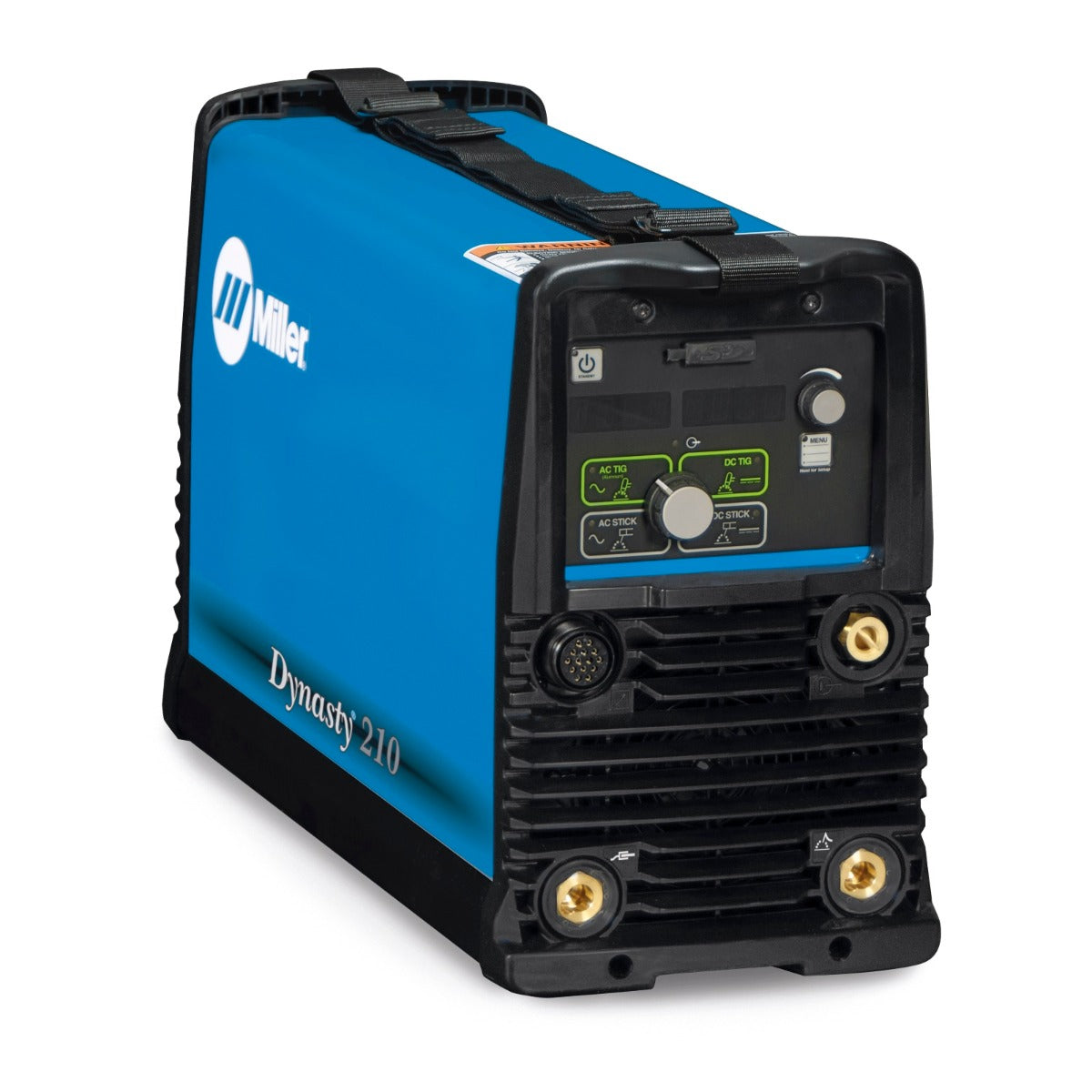
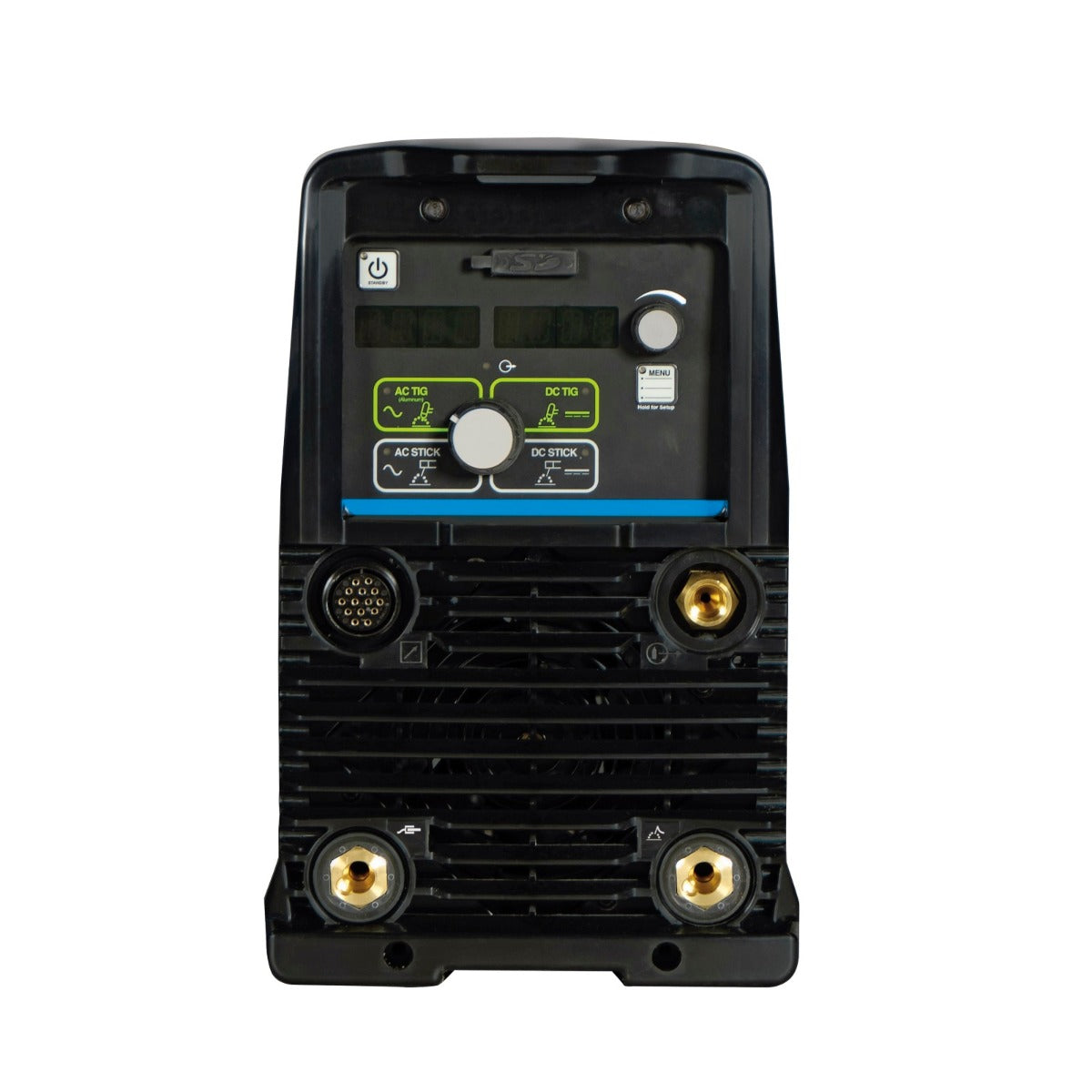
The Miller Dynasty 210 base model offers essential TIG and stick functions while providing an operator-friendly menu.
New Features
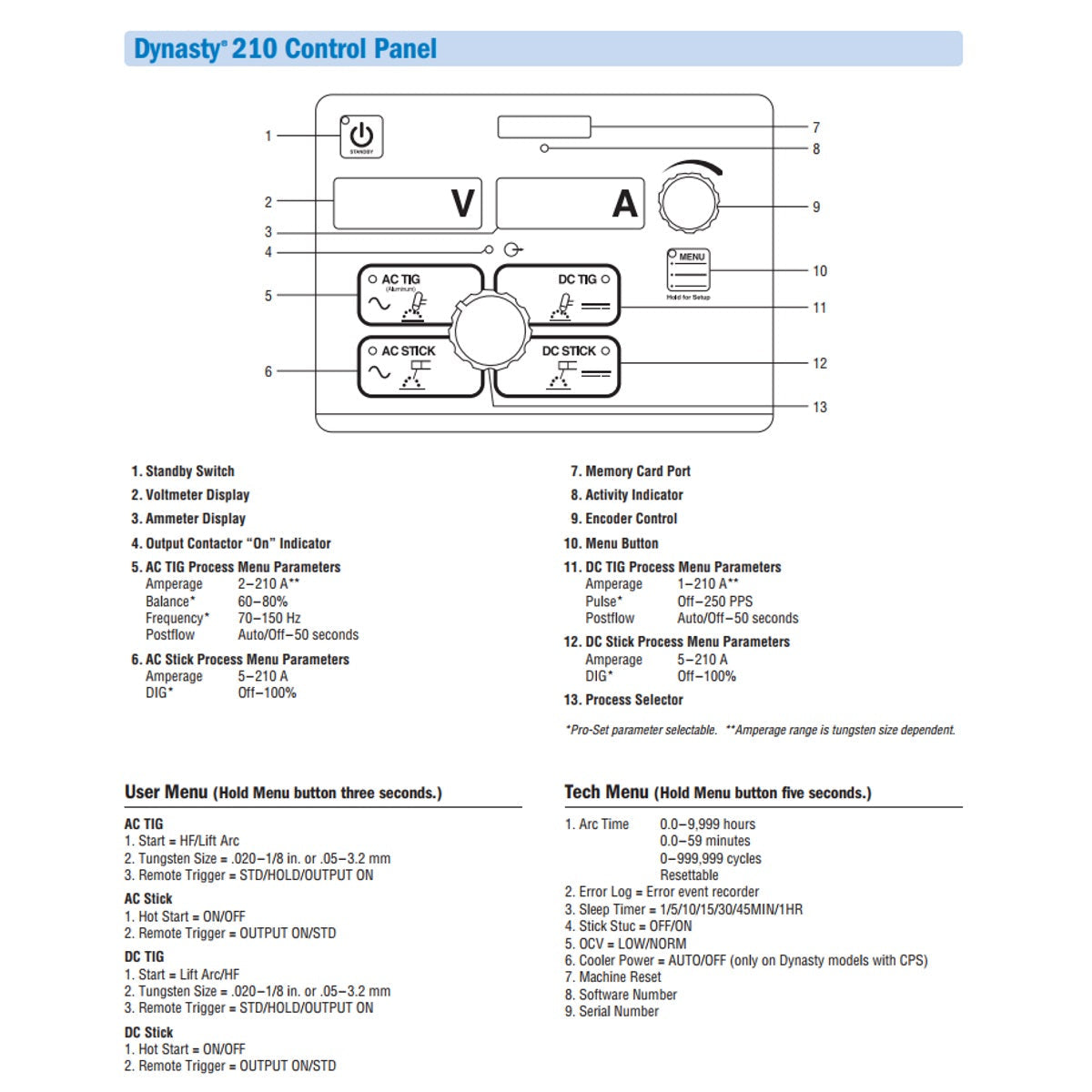
• Memory Card Port - Easily update software & expand product features
• Pro-Set - Eliminates the guesswork when setting weld parameters
• Standby / Power Switch / Sleep Time - Programmable feature will power down the machine if is sits idle for a specified time
Quick Specs
• Process: AC/DC TIG/Stick
• Input Power: 1 or 3 Phase (120-480V)
• Amperage Range: 1-210 A
• Material Thickness: .002 - 1/4" Steel | .012 - 1/4" Aluminum
• Dimensions: 22.4"L X 8.6"W X 13.6"H
• Weight: 47 lbs
• AC Tig Parameters: 60-80% Balance | 70-150 Hz |
• DC Tig Parameters: 0-250 PPS Pulse
• Stick Parameters: 5-210A | 0-100% Dig
Wireless Remote Control Compatible
Improve productivity, eliminate clutter and cord tangles in the work area. Eliminate cord failure and associated downtime/repair costs and extend the operator's welding range without adding cord extensions.
Lift-Arc
Lift-Arc starting provides x-ray clean welds in AC or DC arc starting without the use of high frequency.
Blue Lightning - High Frequency Arc Starter
For TIG non-contact arc initiation. Provides more consistent arc starts and greater reliability compared to traditional HF arc starters. Easy to set up and increases productivity.
Auto-Line Power Management Technology
Allows for any input voltage hookup (115-480 V) with no manual linking, providing convenience in any job setting. Ideal solution for dirty or unreliable.
AC Waveforms
• Advance Squarewave provides a fast freezing puddle, deep penetration, and fast travel speeds.
• Soft Squarewave is used for a soft buttery arc with maximum puddle control and good wetting action.
• Sine wave is for customers that like a traditional arc. It is quiet with good wetting.
• Triangular wave reduces the heat input and is good on thin aluminum. It provides fast travel speeds.
AC and DC TIG Features
• AC balance (60-80%) controls the amount of oxide cleaning (amperage time in EN) which is essential for high quality welds on aluminum.
• AC frequency (70-150 hz) controls the width of the arc cone and the force of the arc.
• DC TIG provides exceptionally smooth and precise arc for welding exotic materials.
Stick Features (AC/DC)
• Tailored arc control (DIG) allows the arc characteristics to be changed for specific applications and electrodes. Smooth running 7018 or stiffer, more penetrating 6010.
• Hot Start adaptive control provides positive arc starts without sticking.
• Low OCV Stick is a simple design that reduces open-circuit voltage to 5-10 VDC when power source is not in use. This built-in circuit design eliminates the need for add-on voltage reducers.
Comes Complete With:
• Dynasty 210 Power Source
• Quick Reference Guide: English | Spanish
• 8 ft (2.4 m) primary cord (No Plug)
• (2) Dinse 50 mm connectors
• Adjustable shoulder strap
New Features
• Memory Card Port - Easily update software & expand product features
• Pro-Set - Eliminates the guesswork when setting weld parameters
• Standby / Power Switch / Sleep Time - Programmable feature will power down the machine if is sits idle for a specified time
Quick Specs
• Process: AC/DC TIG/Stick
• Input Power: 1 or 3 Phase (120-480V)
• Amperage Range: 1-210 A
• Material Thickness: .002 - 1/4" Steel | .012 - 1/4" Aluminum
• Dimensions: 22.4"L X 8.6"W X 13.6"H
• Weight: 47 lbs
• AC Tig Parameters: 60-80% Balance | 70-150 Hz |
• DC Tig Parameters: 0-250 PPS Pulse
• Stick Parameters: 5-210A | 0-100% Dig
Wireless Remote Control Compatible
Improve productivity, eliminate clutter and cord tangles in the work area. Eliminate cord failure and associated downtime/repair costs and extend the operator's welding range without adding cord extensions.
Lift-Arc
Lift-Arc starting provides x-ray clean welds in AC or DC arc starting without the use of high frequency.
Blue Lightning - High Frequency Arc Starter
For TIG non-contact arc initiation. Provides more consistent arc starts and greater reliability compared to traditional HF arc starters. Easy to set up and increases productivity.
Auto-Line Power Management Technology
Allows for any input voltage hookup (115-480 V) with no manual linking, providing convenience in any job setting. Ideal solution for dirty or unreliable.
AC Waveforms
• Advance Squarewave provides a fast freezing puddle, deep penetration, and fast travel speeds.
• Soft Squarewave is used for a soft buttery arc with maximum puddle control and good wetting action.
• Sine wave is for customers that like a traditional arc. It is quiet with good wetting.
• Triangular wave reduces the heat input and is good on thin aluminum. It provides fast travel speeds.
AC and DC TIG Features
• AC balance (60-80%) controls the amount of oxide cleaning (amperage time in EN) which is essential for high quality welds on aluminum.
• AC frequency (70-150 hz) controls the width of the arc cone and the force of the arc.
• DC TIG provides exceptionally smooth and precise arc for welding exotic materials.
Stick Features (AC/DC)
• Tailored arc control (DIG) allows the arc characteristics to be changed for specific applications and electrodes. Smooth running 7018 or stiffer, more penetrating 6010.
• Hot Start adaptive control provides positive arc starts without sticking.
• Low OCV Stick is a simple design that reduces open-circuit voltage to 5-10 VDC when power source is not in use. This built-in circuit design eliminates the need for add-on voltage reducers.
Comes Complete With:
• Dynasty 210 Power Source
• Quick Reference Guide: English | Spanish
• 8 ft (2.4 m) primary cord (No Plug)
• (2) Dinse 50 mm connectors
• Adjustable shoulder strap
| MPN: | MIL907685 |
|---|---|
| UPC: | 715959620062 |
| Processes | AC/DC TIG (GTAW) Pulsed TIG (GTAW-P) Stick (SMAW) |
| Designed For | Shipbuilding Racing Farm and Ranch Manufacturing Heavy Equipment Railcar Aerospace Construction and Fabrication |
| Amperage | 1–210 A (DC) 2–210 A (AC) |
| Material Thickness | Aluminum 0.012 in. (0.3 mm) - 1/4 in. (6.4 mm) Steel 0.020 in. (0.5 mm) - 1/4 in. (6.4 mm) |
| Weldable Metals | Aluminum Specialty Metals Stainless Steel Steel |
| Input Voltage | 110/115/120 V 208 V 220/230/240 V 380/400 V 460/480 V |
| Input Phase | 1- and 3-Phase |
| Input Hz | 50/60 Hz |
| Input Phase | AC / DC |
| Rated Output | 210 A at 18.4 V, 60% duty cycle |
| Max Open Circuit Voltage | 80 VDC |
| Portability | Handle(s) Running Gear / Cart (Optional) Strap |
| Weld Output | 210 A at 18.4 V, 60% duty cycle |
| Weight | 47 lb. (21.3 kg) |
| Warranty | 3 Years Miller's True Blue Warranty |
 Download Product Spec Sheet
Brands you trust at prices you can afford!
Over the past decade, we've become the country's most trusted one-stop online welding shop. We've done it with the guaranteed lowest prices, the best customer service in the industry, and a commitment to providing the best online shopping experience for all welders.
------------------------------


From The Blog

Guide
Should You MIG or TIG Aluminum?
Welding aluminum presents unique challenges due to its heat conductivity and oxide layer. Learn the differences between MIG and TIG welding aluminum, when to use each process, and how to achieve st...

cutting
Which FlexCut Machine Is Right for You?
For those of us welders who’ve been around a while, the story of plasma cutting has been a curious tale. At first, consumer-grade plasma machines were finicky and expensive. Most welders trusted th...

Blue Magic® Anti-spatter: High Performance with No Harmful Chemicals
As a trusted partner of the best brands in welding, we work directly with manufacturers every day to ensure our customers get the best products and service. We're excited to share this guest articl...